
EV vs Hybrid Cars 2025 | Which is Best for Indian Drivers?
If you’re an Indian car buyer in 2025, you’re probably asking: should I buy an EV or a hybrid car? With rising fuel costs, polluted cities, and evolving government policies, the decision isn’t trivial. In this post, we’ll break down the pros and cons of electric vehicles and hybrid cars in the Indian context, compare ownership costs, practicality, infrastructure, and help you decide which is the better fit for your situation.
Why this question matters now
India’s auto landscape is changing fast. Automakers are launching more EV models with improved range and faster charging. At the same time, hybrids are gaining attention as a “bridge” technology. But challenges remain: charging access, taxation, battery life, servicing, etc. The right answer depends heavily on where you live (city / rural), your daily use, and your priorities.
Let’s dive in.
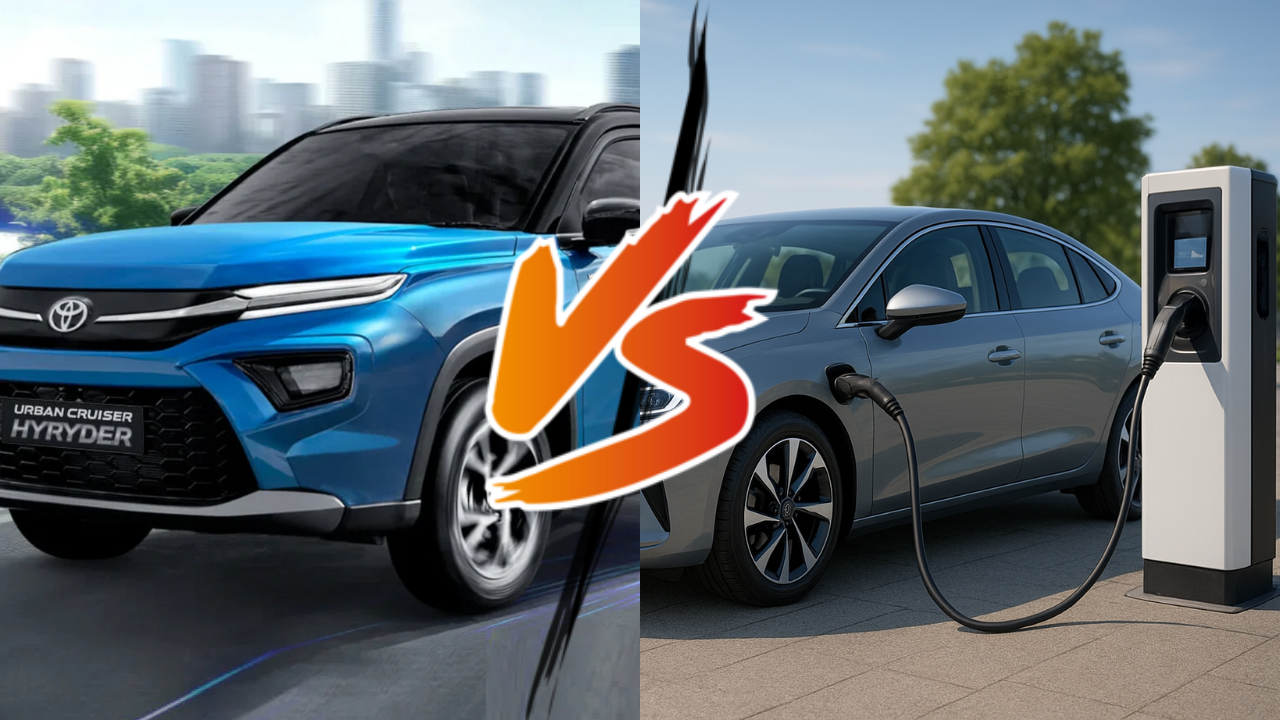
Basic Concepts: What are EVs and Hybrids?
Electric Vehicles (EVs)
- Run solely on electricity stored in a battery pack.
- Use electric motors—no internal combustion engine (ICE) involved.
- Recharge from home chargers or public charging stations.
Hybrid Vehicles
- Use both a petrol (or diesel) engine and one or more electric motors / batteries.
There are different types:
Mild hybrid: electric motor assists engine, but cannot run on electricity alone.
Strong / full hybrid: can drive short distances on electric power alone.
Plug-in hybrid (PHEV): has larger battery and can be plugged in; can run longer on electric only before switching to engine.
Hybrids give you a fallback on conventional fuel if electricity or charging is unavailable.
Purchase Price & Tax / Incentive Landscape
One of the biggest factors for Indian buyers is cost and subsidies.
- EVs currently enjoy lower GST rates and government incentives in many states, making them more attractive.
- Hybrids, however, are often taxed at higher GST slabs (e.g. ~28%), which raises their effective price.
- Some states may give road tax reductions or benefits to hybrids, but most major subsidy schemes are geared toward EVs.
Hence, the upfront price of a hybrid may end up being closer to that of an EV than one expects, especially after taxes.
However: hybrid cars often cost less than full EVs (for similar size / features) in terms of base hardware (engine + smaller battery vs large battery).
So in many cases, a hybrid is a lower-risk, lower-capital entry.
Running Costs & Total Cost of Ownership (TCO)
You must think beyond just buying — how much will it cost over, say, 8–10 years?
| Cost Element | EV | Hybrid |
|---|---|---|
| Electricity / Fuel | Charging an EV is much cheaper (₹/km) depending on electricity tariffs | You still pay for petrol, though consumption is reduced |
| Maintenance & Servicing | Fewer moving parts, no oil changes, less wear & tear—but battery degradation is a worry | More complex drivetrain (engine + battery + motor) – more maintenance possibilities |
| Battery Replacement | Battery packs may need replacement or health degradation over ~7–10 years | Hybrid battery usually smaller and cheaper to replace |
| Resale / Depreciation | EV resale is evolving; concerns over battery health | Hybrid resale is more familiar and accepted for now |
Because electricity (per km) is usually cheaper than petrol, over time the EV can become more economical — especially if your usage is high and charging is convenient.
Range, Charging & Infrastructure
This is one of the biggest differentiators in India.
- EVs depend entirely on charging infrastructure. In a well-connected city with many charging stations, EV is a good bet. But in towns, rural areas, or places with weak infrastructure, charging can be a headache.
- Hybrids offer continuity: when battery is empty or charging isn’t possible, the internal combustion engine keeps you going.
- For long highway trips, hybrids currently offer more flexibility (no “range anxiety”).
- That said, EV range is improving rapidly, and high-powered DC fast charging is becoming more available in metro corridors.
If your usage is mostly within city limits, daily commute, and you can charge at home or work — EVs become more viable.
Environmental & Emissions Considerations
One reason many people lean toward EVs is environmental benefits.
- Tailpipe emissions: EVs produce zero tailpipe emissions. Hybrids still burn fuel when the engine is used, so they emit CO₂, though less than pure ICE vehicles.
- Lifecycle emissions / battery manufacturing: EV battery production uses energy and raw materials (lithium, cobalt, etc.), which have environmental cost. Over the full life cycle, EVs tend to come ahead, especially if the electricity grid becomes greener.
- In India, as renewable energy sources increase in grid share, the “cleanliness” of EVs improves progressively.
Thus, from an environmental viewpoint, EVs tend to be the stronger long-run choice.
Practical Use Cases: Which One Suits You?
Not everyone has the same driving pattern or constraints, so the “best” choice depends on your situation. Here are scenarios:
Scenario A: Urban commuter, short daily run, access to home/work charging
- EV shines here. You’ll rarely use full battery; you charge overnight or at work.
- Minimal maintenance, lower running cost.
- No fuel station dependency.
- You’ll benefit most from incentives and reduced operating cost.
Scenario B: Frequent intercity / highway travel
- Hybrids give security when charging is scarce.
- You don’t need to worry about planning charging stops.
- Your “worst-case scenario” is still covered by the engine.
Scenario C: Living in semi-urban/rural area, weak grid, unreliable electricity
- Hybrid is safer: even if electricity supply or charging is unreliable, you have petrol fallback
Scenario D: You drive high mileage daily (say for business / ride services)
- You might benefit from EVs if charging infrastructure is accessible; the lower cost per km adds up.
- But you must carefully plan downtime, charging logistics, etc.
Real Data & Market Trends in India (2025)
- In 2025, hybrid car sales still outnumber EV sales in some segments in India.
- Automakers are preparing a wave of EV launches in 2025 with improved range and faster charging.
- However, the hybrid vehicle segment is expected to grow strongly (CAGR ~18%) and may cross ₹18,500 crore in India.
- One forum commenter said: “Hybrid cars are only efficient in the city … EVs powertrain designs are going to reimagine cars.”
- The EY report notes that hybrids may serve as a practical bridge until EV infrastructure scales.
These trends suggest that while EVs are the aspirational future, hybrids remain a competitive, realistic option for many in India — especially in 2025.
Pros & Cons (Quick Checklist)
EV — Pros
- Zero tailpipe emissions
- Lower running cost per km (electricity cheaper)
- Fewer mechanical parts → less wear & tear
- No fuel stops, quieter driving
- Benefiting from subsidies, lower taxes in many states
EV — Cons
- Dependent on charging infrastructure
- Range anxiety in some cases
- Battery degradation risk
- Higher upfront cost (especially in some locations)
- Charging time vs refueling time
Hybrid — Pros
- Flexibility: petrol fallback
- Better fuel efficiency and reduced emissions vs ICE
- Lower battery cost (smaller battery)
- Familiar service ecosystem
- Good for mixed use (city + highway)
Hybrid — Cons
- Still emits CO₂ (when engine runs)
- More mechanical complexity → potential for more component failure
- Higher GST / tax burden in India
- Savings in fuel may not match EV in long term
Which is Best for Indian Drivers in 2025?
Given all this, here’s a rough guidance, depending on your priorities:
- If you live in a city / metro and have reliable charging access (home or workplace) → EV is often the better pick
- If you travel often outside cities / highway, or live in areas with poor charging infrastructure → Hybrid gives better peace of mind
- If your work or usage demands high daily mileage → EV can pay off over time if charging convenience exists
- If you are conservative and want lower risk today → Hybrid is a safer middle ground
- If you care strongly about environmental impact → EV has the edge in the long run
Also, always compare Total Cost of Ownership (TCO) over 5–8 years, not just purchase price.
Tips for Indian Buyers
- Check local incentives and subsidies in your state. Some states give extra benefits for EVs (lower registration fees, tax benefits).
- Plan your charging strategy — home charger, workplace charger, public chargers along route.
- Check battery warranty — how many years / km, and replacement cost.
- Service network & spares — make sure your chosen brand has support in your region.
- Consider residual value — as EV adoption rises, battery health will influence resale.
- Watch policy changes — India’s policies around taxation of hybrids / EVs may shift. The government may reduce GST on hybrids to level the playing field.
Final Thoughts
In 2025, there’s no one-size-fits-all answer to “EV vs hybrid for Indian drivers.” Each has strengths and trade-offs. EVs represent the future — cleaner, cheaper to run, and increasingly convenient — but they require good charging infrastructure and careful planning. Hybrids, meanwhile, offer a safer, more flexible path today, especially in regions where EV support is still nascent.
If I were you, I’d make a chart of your usage pattern, charging access, budget, and priorities — then see which side your situation leans toward. Over a decade, the cost benefits and environmental gains of EVs make them very compelling — but hybrids are still extremely viable for many Indian drivers today.